

What is ultimate frisbee
Ultimate is a non-contact team sport played with a 175-gram flying disc. Two teams of seven compete on a rectangular field with end zones at each side. The objective is simple: move the disc downfield by passing it to teammates until a player catches it in the opposing end zone for a point. Unlike many traditional sports, there are no referees. Players enforce the rules themselves, relying on a shared commitment to fair play known as the "Spirit of the Game."
The game flows continuously without stoppages for fouls, except when the disc hits the ground, goes out of bounds, or a foul is called. This self-officiating culture requires honesty, respect, and clear communication. It creates a unique dynamic where competitive drive is balanced with mutual respect, ensuring the game remains fast-paced and enjoyable for all skill levels.
The sport is governed globally by the World Flying Disc Federation (WFDF) and in the United States by USA Ultimate. These organizations provide standardized rules that ensure consistency across casual pickup games and competitive tournaments. Whether you are playing on a sunny park field or in a formal league, the core mechanics remain the same: pass, catch, score, and respect your opponents.
Gather the right frisbee gear
You don’t need expensive equipment to start playing ultimate frisbee, but the right tools make the game safer and more enjoyable. The disc is the only piece of gear that strictly defines the sport, while footwear and apparel protect your body during sprints and cuts.
Choose the right disc
The official disc for ultimate frisbee is a 175-gram flying disc. This weight is the standard for competitive play because it offers a good balance between wind resistance and throwing distance. If you are just starting out, a 175g disc is the best choice. Lighter discs (160g or below) are easier to throw but fly poorly in windy conditions, which is common on outdoor fields.
Discs are categorized by flight ratings, typically ranging from 1 to 13. For beginners, look for discs rated between 2 and 4. These "beginner" or "practice" discs are softer and more forgiving, allowing you to focus on form rather than fighting the plastic. As you improve, you can graduate to higher-rated discs that fly faster and further.
Wear appropriate footwear
Your shoes are critical for preventing injuries. Ultimate involves a lot of lateral movement, sudden stops, and pivoting. Standard running shoes are not designed for this; they often have high centers of gravity and smooth soles that can slip on turf or grass, leading to ankle rolls.
Instead, wear cleats or turf shoes. Molded plastic cleats are ideal for natural grass, providing traction without damaging the field. For artificial turf, turf shoes with small rubber nubs offer the necessary grip and stability. Avoid metal cleats unless you are playing on a specific metal-cleat-allowed field, as they can be dangerous in a non-contact sport.
Select comfortable apparel
Wear breathable, moisture-wicking athletic clothing. The game is high-intensity, and cotton shirts will become heavy and uncomfortable when wet with sweat. Shorts should allow for a full range of motion; avoid jeans or restrictive pants. Many players prefer compression shorts underneath for added comfort and protection during dives or falls.
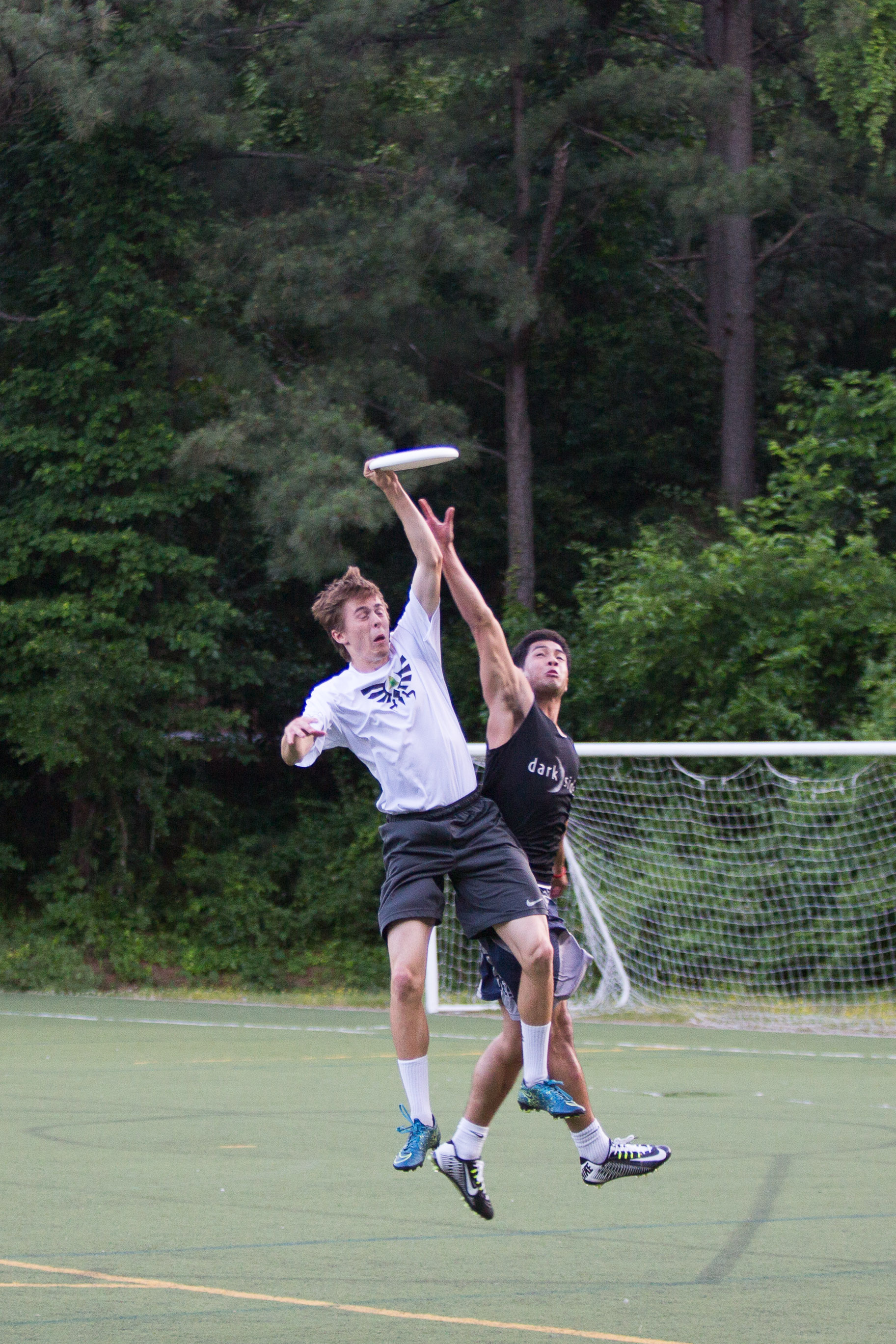
Master the two basic throws
Ultimate Frisbee relies on two fundamental throwing techniques: the backhand and the forehand (often called the flick). The backhand is the easiest to learn and serves as the foundation for most players. The forehand is essential for navigating tight spaces and changing direction quickly. Learning these two mechanics allows you to move the disc effectively across the field.
The backhand throw
The backhand is your primary throwing tool. It is natural for right-handed players and forms the basis of most offensive plays.
Place your index finger along the rim of the disc, with the tip just inside the inner edge. Tuck your middle and ring fingers underneath the rim for support. Your thumb rests on top of the disc, near the center, to stabilize it during the throw. This grip provides control without restricting wrist movement.
Stand with your feet shoulder-width apart. If you are right-handed, position your left foot forward and your right foot back. Keep your knees slightly bent and your eyes on the target. Hold the disc close to your chest, keeping your elbow tucked in. This stance creates a stable base for generating power.
Pull the disc across your body from right to left, keeping your arm straight. As the disc passes your hip, rotate your hips and shoulders toward the target. Snap your wrist forward at the last moment to release the disc. Aim for a flat flight path, letting the disc glide smoothly toward your receiver.
The forehand (flick) throw
The forehand is crucial for quick releases and throwing to the opposite side of your body. It is particularly useful when you are surrounded by defenders or need to change direction rapidly.

Place your index finger along the rim, similar to the backhand, but with your palm facing up. Tuck your middle and ring fingers under the rim. Your thumb rests on top of the disc. This "palm-up" grip allows for a different wrist snap and flight path compared to the backhand.
Stand with your feet shoulder-width apart. If you are right-handed, position your right foot forward and your left foot back. Hold the disc close to your chest, keeping your elbow tucked in. Look at your target and prepare to rotate your hips and shoulders.
Pull the disc across your body from left to right, keeping your arm straight. As the disc passes your hip, rotate your hips and shoulders toward the target. Snap your wrist forward at the last moment to release the disc. The forehand typically releases with a higher arc than the backhand, so adjust your aim accordingly.
Common mistakes to avoid
Many beginners struggle with grip pressure and wrist snap. A tight grip restricts wrist movement, leading to weak throws. Practice holding the disc loosely, allowing your wrist to snap freely at release. Another common error is throwing with only the arm. Engage your hips and shoulders to generate power and accuracy. These fundamentals take time to master, so focus on consistency rather than distance in your first games.
Understand field layout and scoring
Ultimate Frisbee is played on a rectangular field with two end zones, one at each end. The total field length, including end zones, is typically 120 yards for competitive play, with each end zone being 20 yards deep. For casual or beginner games, you can scale this down to a soccer-field size, but the proportions remain the same: a central playing area flanked by two scoring zones.
The primary objective is to score points by catching the disc in the opponent’s end zone. When a player makes a successful catch in the end zone, their team earns one point. Unlike many sports, there are no touchdowns worth different values; every catch in the end zone counts as a single point. After a goal is scored, the teams switch sides of the field, and the opposing team restarts play with a "pull"—a throw similar to a kickoff in football or rugby.
Understanding the layout helps you visualize spacing and movement. The central area is where most of the passing and cutting happens, while the end zones are where the action culminates. Players must stay in bounds; if the disc touches any part of the sideline or end zone line, it is considered out, and possession is turned over to the other team. This simple structure keeps the game fast and fluid, with continuous movement and clear objectives.
Follow the core movement rules
These three rules govern how the disc moves and how players interact with it. Mastering them prevents the most common turnovers for new players.
The pivot foot
Once you catch the disc, you must establish a pivot foot. This foot stays planted on the ground while you move the rest of your body to throw. You can rotate around this foot, but you cannot drag it, lift it and put it down elsewhere, or take steps with it. Think of your pivot foot as an anchor; if you slide it, it’s a travel violation.
The stall count
The defender marks the thrower by standing within three meters and counting aloud. The standard count goes to ten. If the thrower has not released the disc by the time the defender says "ten," it is a turnover. The count resets after every throw. This rule keeps the game fast-paced and prevents players from holding the disc indefinitely.
Traveling
Traveling occurs when the pivot foot moves illegally. This includes lifting the pivot foot and placing it down again before throwing, or taking steps with the pivot foot. Even a small shuffle counts. If you are unsure whether you traveled, it is usually best to call it on yourself. Ultimate relies on the Spirit of the Game, where players are responsible for their own infractions.
Prepare for your first game
Arriving early is the single best way to ease the pressure of your first Ultimate Frisbee match. Aim to get to the field at least 30 minutes before kickoff. This buffer gives you time to check in with the organizers, locate the correct field, and warm up your legs without feeling rushed. A proper warm-up—light jogging, dynamic stretches, and some short throws—prepares your muscles for the sudden sprints and cuts that define the sport.
Hydration is critical, even on cloudy days. The continuous movement involved in playing ultimate can lead to dehydration faster than you might expect. Bring more water than you think you need, and consider a light snack like a banana or granola bar for quick energy. Avoid heavy meals right before the game to prevent discomfort during play.
When you arrive, take a moment to introduce yourself to the team. Ultimate is known for its friendly community, and most players are happy to welcome a newcomer. You don’t need a rehearsed speech; a simple "Hi, I’m new here, looking forward to playing" is enough. This small gesture helps break the ice and sets a positive tone for your first match.
Before you head onto the field, run through this quick checklist to ensure you’re fully prepared for the experience.
Watch a beginner tutorial video
Visualizing the flow helps clarify the rules faster than reading them alone. Watch this beginner tutorial to see the basic gameplay mechanics in action. It covers the core rules for both UFA and college versions, showing how the disc moves and how players position themselves.
Common questions for new players
Ultimate Frisbee relies on self-officiating, which means the rules are enforced by the players on the field rather than referees. This system works only if everyone commits to the "Spirit of the Game," the sport's core principle of sportsmanship and fair play.
No comments yet. Be the first to share your thoughts!